

History, Structure, and Cleaning of Paintbrushes
Home » Uncategorized » History, Structure, and Cleaning of Paintbrushes
A Brief History of Brushes
Brushes have been used since the time of cave paintings, which were created using bundles of animal hair tied to a handle. Instead of animal hair, the ancient Egyptians used crushed and shredded reed stems and fibers.
Although it is still In the 14th century, Chenino Chenini described in detail how brushes are made (made from pig bristles and squirrel hair) in his “Treatise on Painting”; at that time, it was not yet a distinct craft. The artists made their own brushes. In the 16th century, several artisans in France specialized in their production and export.
By the 17th century, the craft had taken root in Germany as well, more specifically around Nuremberg and the surrounding villages. Today, most of the master painters and workshops are located there. Gradually, such artisans began to appear in England, the United States, and Brazil as well. In the Far East, and particularly in China, brushes were being made as early as thousands of years ago, with bristles and shapes suited to their traditional painting techniques. In recent decades, this type of brush has also spread to the West. Over time, experts specializing in the manufacture of “Western-style” brushes have emerged in China and, especially, in Japan.
Manufacturing and Brush Components
The Hair
Often, when people refer to a brush, they mean specifically its bristle tip, which is only part of the brush. In the case of natural-bristle brushes, it is very important to know which part of the animal the hair comes from —it may, for example, come only from the tail or the ears.
The manufacturing process is complex and precise. First, the hair strands are trimmed and sorted by length and color so that their tips point in the same direction. Then, the remaining hair is combed out using special combs. Master brushmakers have a keen sense of how many strands to set aside for each brush size; they then tie them into the perfect shape and insert them into the ferrule.
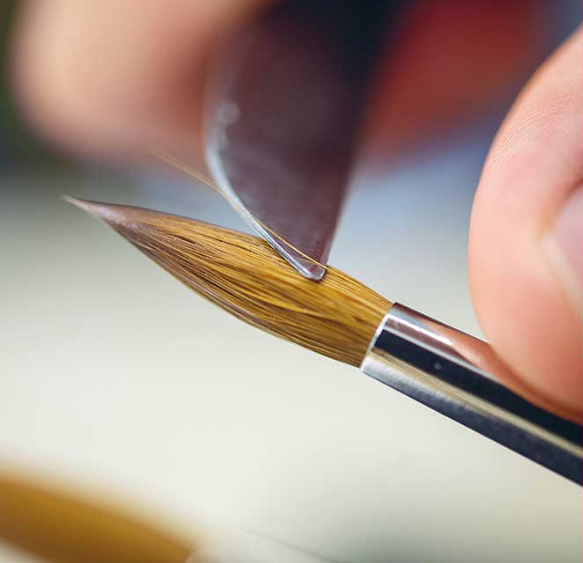
The ferrule is the connection between the handle and the bristles. The best brushes are made with a seamless stainless steel or brass ferrule, which may also be nickel-plated, while cheaper ones use aluminum or tin ferrules. The bundle of bristles is secured in the ferrule with a strong adhesive that is resistant to all types of solvents.
The Ferula
The Handle
The brushes come in a wide variety of lengths. Short brushes are typically used for painting on a desk or table and for small paintings. Brushes with long handles act as an extension of the hand for larger works and for painting on an easel. Using them gives the artist a better view of the entire painting.
The higher the quality of the brush, the more times the handle has been varnished, thus protecting it from water or solvents. Moisture can cause the wood to swell significantly and then shrink, which weakens the ferrule’s grip. The handles of lower-priced brushes are usually not varnished.
Care
The life of a brush can be significantly extended with proper use and care. This is especially true for the brushes we use with quick-drying and waterproof paints, such as acrylics.
We should never store soft-bristle brushes with the bristles pointing downward, as this can cause irreversible damage.
Cleaning
After finishing work, the brushes can be cleaned as follows:
First, wipe the brush clean, then squeeze out any remaining paint by hand, working from the ferrule toward the tip of the bristles.
Water-soluble paints are rinsed off with water, while alkyd and oil-based paints are dissolved in white spirit.
Next, wash the brush with mild soap and warm to hot water. The bristles can be lathered directly with the soap. Repeat until the foam on the brush is completely clean.
Rinse thoroughly with water and shake dry.
The wet bundle of bristles is shaped into a point, and the brush is left to dry in a horizontal position.
Paint-hardened brushes
Brushes that have been left uncleaned and have hardened can still be salvaged.
Water-soluble paints, such as watercolor and gouache, can be easily washed off using the method described above.
Acrylic, however, which becomes water-resistant once dry, can only be removed with a specialized product such as Amsterdam 013 brush cleaner. Soak the brush in the liquid for about an hour, then clean it, taking care to avoid contact with the handle, as the varnish on it may dissolve. The cleaner is powerful but completely biodegradable and safe for the environment.
As for oil paints—they dry very slowly, and brushes can usually be cleaned promptly without any difficulty. If, for some reason, oil paints do dry on the brush, they can be dissolved with very strong thinners.
Numbering
When selecting brushes (for example, from a list), it is important to note that the dimensions of each type and their corresponding thickness vary depending on the country of origin, the manufacturer, and sometimes even between different lines within the same brand.
Translation from Royal Talens’ Artists’ Materials Manual (2020): Martina Petrova


