

How and from what are paints made?
Home » Uncategorized » How and from what are paints made?
Ingredients
Paints (as well as pastels and ink) are made primarily from pigments and binders, supplemented by fillers, solvents, and other additives.
We can classify colorants into pigments and dyes. The color, opacity (or transparency), and lightfastness of the paint depend on these.
The binder protects the pigments and determines the adhesion (the paint’s ability to adhere to the surface) and the paint’s properties. Some binders are dry solids that must first be dissolved or mixed with a diluent (such as water or white spirit), so that they turn into a liquid. The solvents evaporate from the paint as it dries.
Fillers are usually calcium carbonate products (calcium carbonate is used to make chalk , for example) and are used for a variety of reasons. Some pigments are so intensely colored that a dye made entirely from them would be difficult to use, because the color would overwhelm the others. There are also pigmentsthat have an adverse effect on the paint, making it sticky and unusable unless a filler is added. Fillers are also used in the production of lower-quality paints. Because they are cheaper, they replace part of the coloring agent, which is often quite expensive. Adding a filler does not reduce the paint’s durability.
Last but not least, “other additives” refers to substances that increase the stability of the paint or affect its other properties. Examples include condensers, siccatives (drying agents), preservatives, and thinners.
Manufacturing. Pigment dispersion
Since the pigments do not dissolve in the liquid or liquefied binder, they must be regularly stirred or dispersed within it. Dry pigments arrive in lumps, which are broken down into increasingly finer particles and coated with a protective layer of binder. The finer the dispersion (the finer the uniformly dispersed particles), the stronger the paint’s coloring properties. Depending on its specific characteristics and the paint for which it is intended, the pigment It is ground into particles ranging in size from 2 to 50 microns (1 micron = 1/1000 of a millimeter). If undesirable changes occur in its chemical composition during dispersion, the shade of the paint also changes.
Stages
Pre-mixing
Initial crushing of the large lumps pigment is done using an industrial mixer, which blends them with the liquid ingredients.
Pigment Grinding
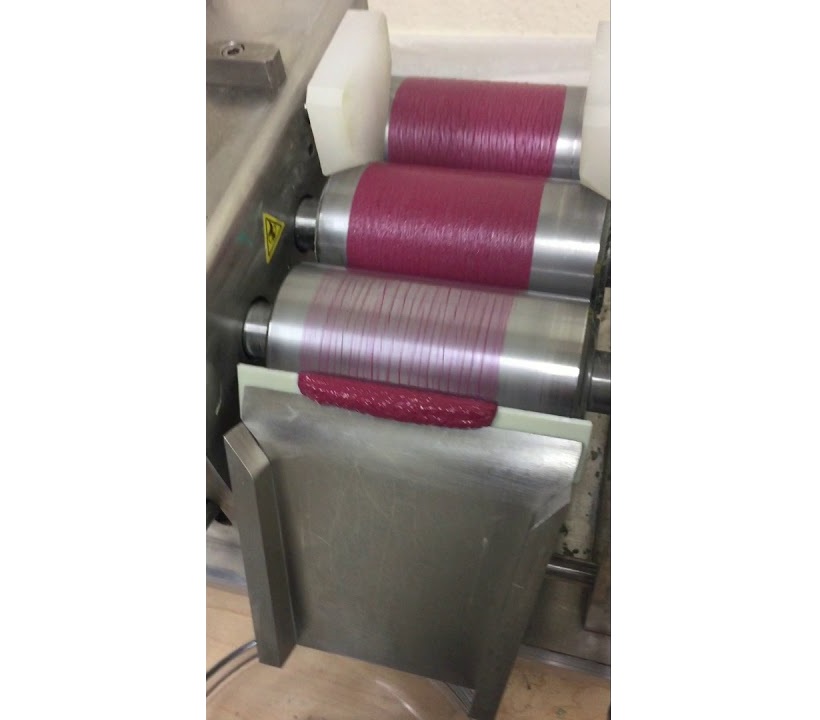
The removal of pigment is performed using a triple-roll mill with hardened steel rolls that rotate in different directions at different speeds. The speed of each subsequent roller is 3 or 4 times greater than that of the previous one. The difference in rotational speed breaks up the clumps. pigment and the paint is transferred from one roller to the next. At the end, it is scraped off with a knife.
The fineness of the particles is determined by the distance between the rollers. If they are not positioned correctly, they can give the paint a shade different from the desired one or be damaged by the hardness of the pigment. That is why they are initially spaced apart, and the distance between them gradually decreases. Depending on the desired color and properties of the paint, as well as the fragility of pigment, the pressing process is repeated up to 5 times. Hollow on the inside, the rollers can be cooled with water to prevent the pigments from burning due to friction.
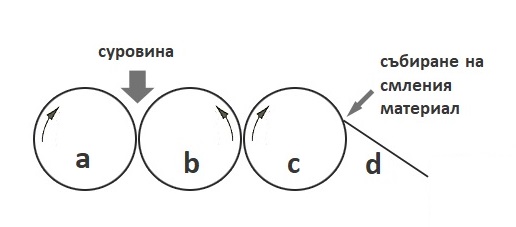
a = input shaft, speed ratio 1
b = central shaft, stage 3
c = scraping shaft, grade 9
d = scraping blade
Fineness Check
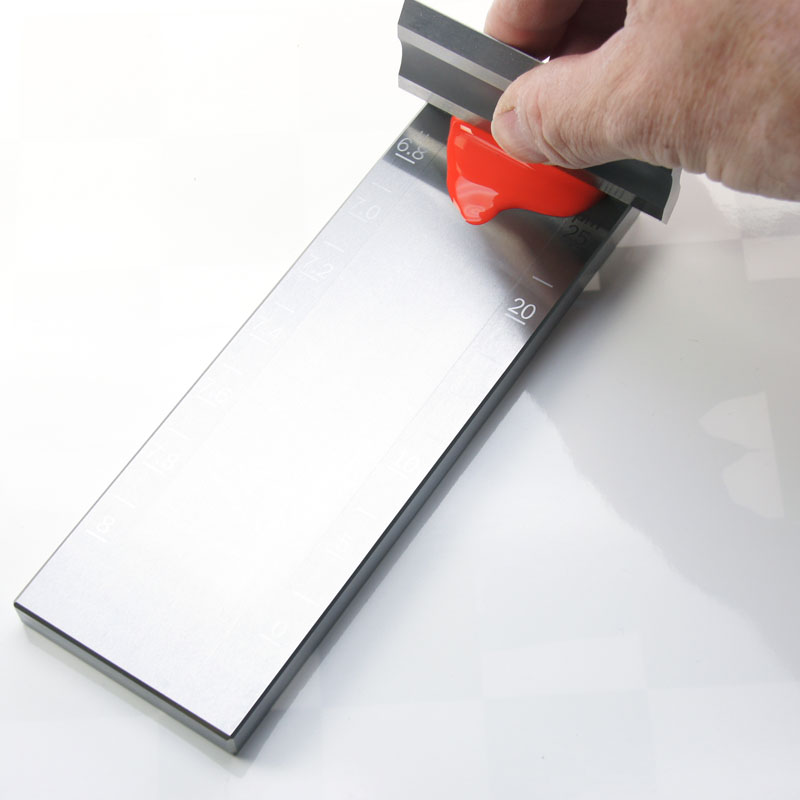
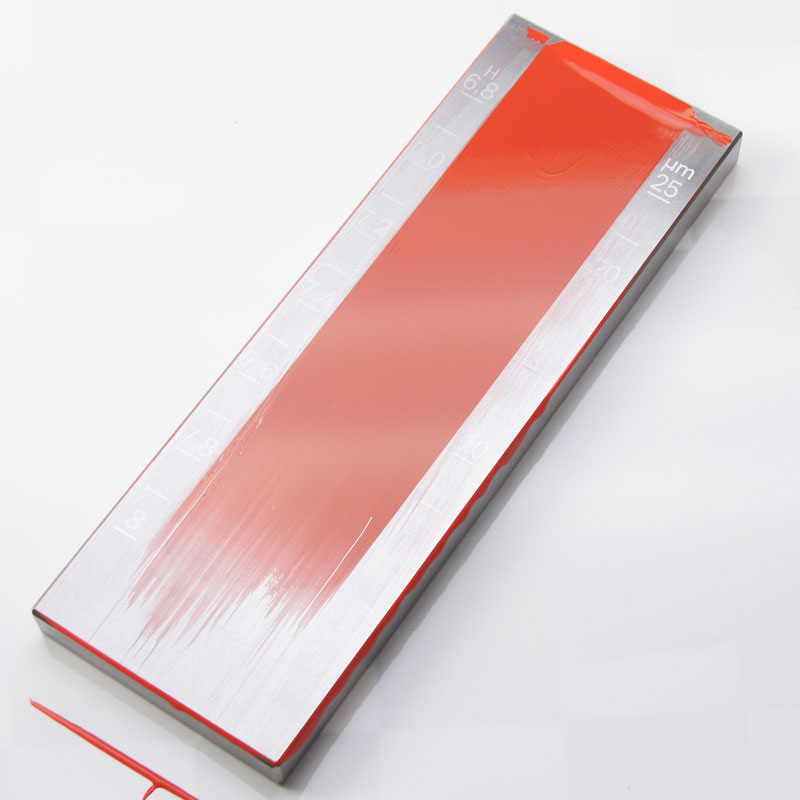
After grinding, the fineness of the pigments is checked using a Hegman grindometer (from the English grind): an elongated steel measuring device with a scale running parallel to an extremely shallow channel along which the paint is drawn. Where the pigment particles are larger than the thickness of the paint layer, they protrude above it, which is visible to the naked eye and allows for measurement.
Color Comparison
Each color obtained is observed under light of a specific brightness, as close as possible to natural daylight, and is compared to a reference color. The paint is applied in both thin and thick layers over a white base so that both the base color and its shade are visible. Both must match those of the target shade.
Translation from Royal Talens’ Artists’ Materials Manual (2020): Martina Petrova


