

General Information About Paper
Home » Uncategorized » General Information About Paper
Paper can be produced from a wide variety of plant-based raw materials. Japanese rice paper is very famous, but there are actually specific varieties that are also made from grasses and tree bark.
Before the advent of synthetic fibers, artists’ paper was made mainly from rags. Old clothes and textiles were ground into a pulp, after which the knots were filtered out and removed, and the residue was mixed with glue.
Since most fabrics today contain synthetic fibers, unwanted textiles are not a suitable raw material for paper production, a role that is instead filled by cotton and wood. Synthetic paper is now also being produced from acid-free polypropylene.
A Brief History of Paper
The origins of paper can be traced back to the papyrus plant, whose stems were used to make sheets for writing and drawing as early as around 4000 B.C. The stems were split in half, flattened, and arranged side by side; then a second layer was laid perpendicular to the first, pressed, and dried.
Papyrus, the paper of the same name, continues to be produced using the same technology in Egypt, but mainly for souvenirs. Sometime around the 2nd century AD, papyrus was replaced by the much more durable parchment, made from animal hides.
The form of paper we know today originated in China. The invention of the first sheet of paper in 100 AD is attributed to Cai Lun. To do this, he ground the bark of the so-called paper mulberry, old fishing nets, and ropes, and mixed them with water to form a pulp. He then spread the mixture on a bamboo sieve and let it drain and dry in the sun so that the fibers would bind tightly together. Paper production is still based on this principle today.
Ingredients
Cotton
The raw material from the first cotton harvest is set aside for textile production. The remaining cotton on the plant is pressed into bales or sheets, from which the shorter cotton fibers are separated again and carded. During the carding process, the length and structure of the fibers are determined. Thanks to these qualities, its proven durability, and its low susceptibility to discoloration from light, cotton is the optimal material for making high-quality paper.
Tree
Paper made from wood can vary greatly in quality. High-quality paper is made by converting pure cellulose into fibers. The resulting fibers are slightly shorter than those of cotton but are just as lightfast. The more wood pulp (ground wood) a paper contains, the less durable it is and the more prone it is to discoloration. Cellulose fibers are also pressed into bales or sheets, which are then soaked and purified before being pulped. Paper made entirely from cellulose is referred to as wood-free paper.
The Most Important Aspects of Production
Liquid paper pulp consists of 99% water. Long-lasting and durable papers are made using pH-neutral or low-acid water. pH-neutral means neither acidic nor alkaline. Gelatin can be added to the pulp, the amount of which determines the absorbent properties of the paper, and calcium carbonate CaCO3, which neutralizes its acidity.
The pulp is spread onto a mold and allowed to drain to 65% of its water content, after which it is firm enough for the next step—transferring it onto felt. The felt determines the texture of the paper’s front side (or its “tooth”). After being further dried by the fabric, the paper passes through a steam-drying drum.
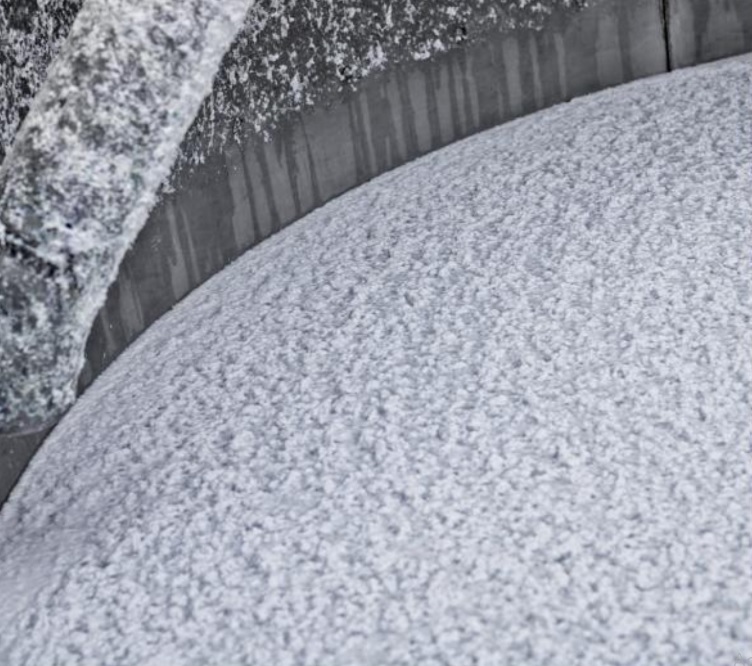
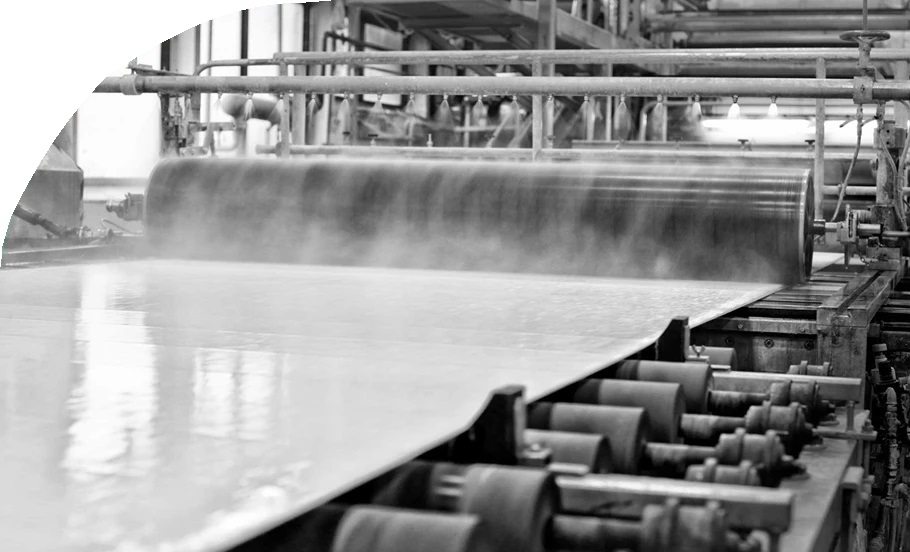
After passing through the drum (and reaching a moisture content of 30%) , the high-quality watercolor paper is treated with an adhesive, which is most often gelatin-based but can also be plant-derived or synthetic. It then undergoes a second drying cycle to reach a moisture content of 6–7%.
To change the texture of the paper, it undergoes additional pressing. The coarsest, coarse-grained texture is achieved by simply letting it dry. Medium-textured paper is produced using a cold press, while the smoothest, fine-textured paper is produced using a hot press (hence the terms “cold-pressed” and “hot-pressed” paper). The density of the paper is determined by the amount of pulp persquare meter, the pressure, and the temperature at which it is pressed.
Handmade paper
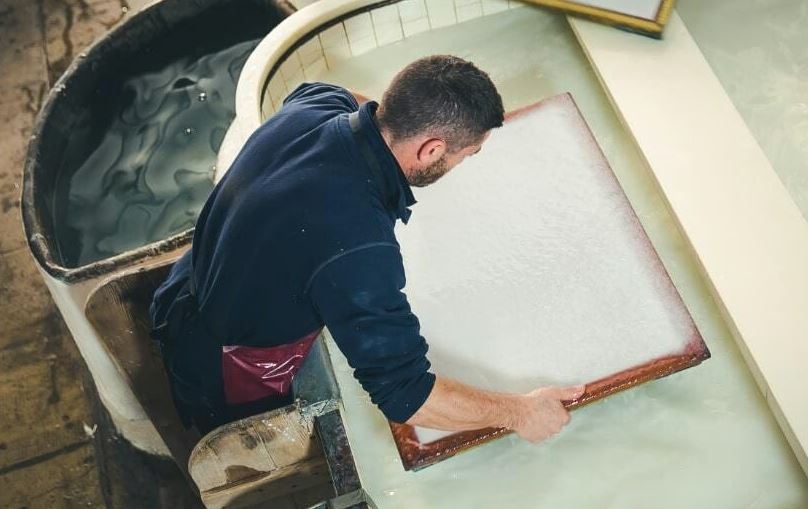
Each handmade sheet begins by scooping up the paper pulp with a fine rectangular sieve of the desired size. Once the water has been strained off, the sieve is shaken so that the fibers interlace and distribute themselves evenly, allowing them to absorb water uniformly during the forming process. After draining, the pulp is turned onto a felt pad, onto which a new piece of fabric is placed, and so on until a large stack of sheets has been built up; these are then pressed and left to dry. Handmade paper is characterized by its uneven edges, shaped by the frame of the screen.
Cylindrical Mold Manufacturing
Cross-woven paper can also be produced by machine. In this case, the mold consists of a large cylinder immersed in a container of wet pulp. The closed cylinder filters the water out of the container, causing the fibers to adhere to its outer surface. At the highest point of the rotation, the resulting pulp sheet is transferred back onto a felt to be drained. It then proceeds to the first drying drum, sizing, the second drying cycle, and, if necessary, to the press.
This is how the best watercolor paper is produced. The adhesive coating is very precisely measured and distributed so that it captures and holds the pigments in the surface and they look as bright and saturated as possible.
How Are Long Sheets of Paper Made?
Fourdrinier’s machine for producing long sheets of paper consists of a long conveyor belt onto which the wet pulp mixture is sprayed, which aligns the fibers lengthwise. This is the direction in which the paper is more vulnerable and can easily tear or fold, but is also more difficult to roll up. It is important to note that, when produced this way, the paper absorbs water from the inks more unevenly and is more susceptible to deformation from moisture. After passing through the long mold, the sheet is transferred to a felt pad, where it dries and is pressed.
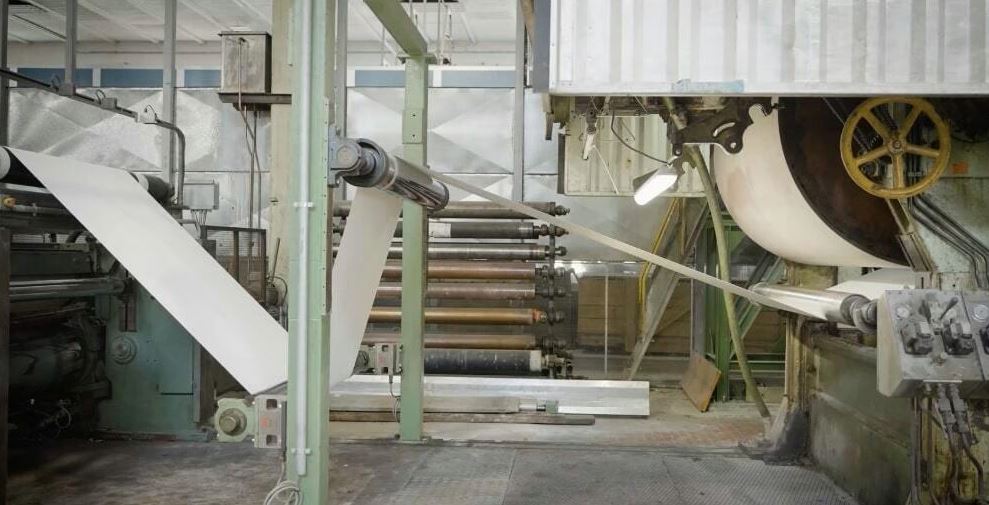
The production capacity of this type of machine is much greater, which lowers the price of paper. Its quality can be improved by adjusting the flow mold to oscillate in opposite directions, so that the fibers are distributed more evenly. Even with this step, however, paper produced with a cylindrical mold is superior.
Factory-made sheets are further cut to size, and in some cases are “cut” with a powerful water jet while still wet to mimic the naturally shaped edges of handmade paper.
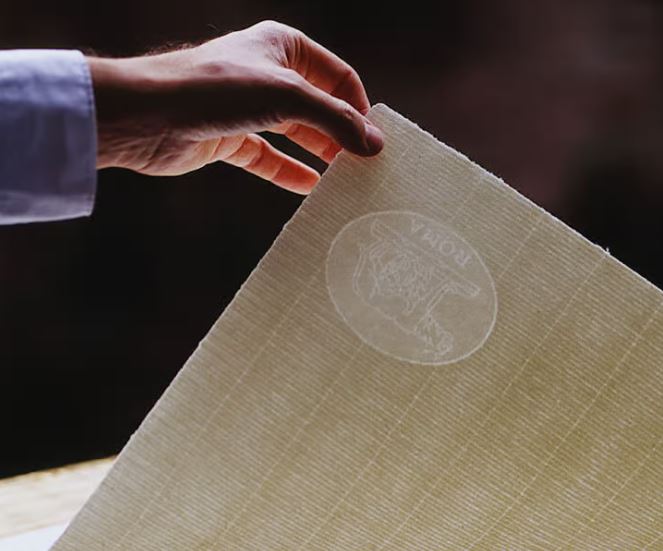
Their obverse side is usually marked with a watermark or an embossed stamp.
Translated from Royal Talens’ Artists’ Materials Manual (2020): Martina Petrova


