

Types of candle wax. Wicks, fragrances, and containers for making candles.
Home » Блог » Сезонна Декорация » Коледа » Types of candle wax. Wicks, fragrances, and containers for making candles.
Which type of candle wax should we choose?
Making high-quality candles that burn evenly, that create a cozy atmosphere is a science in itself, and choosing the right wax for candles is therefore crucial.
The candle market, which has gained popularity recently, now offers eco-friendly and luxury alternatives such as coconut, palm, and rapeseed wax. However, paraffin, beeswax, and soy wax remain the most common and affordable options, and they are also easy for beginner candle makers to work with.
Candle paraffin is a petroleum product that is undoubtedly the most affordable of all waxes. It is easy to use, with a high melting point and hardness, allowing it to be molded into a wide variety of shapes and decorative molds. Among its greatest advantages are its ability to retain color and scent. Crystal-clear in its liquid state, paraffin is excellent for dyeing.
Paraffin candles give off a strong scent both when cold and when burning (known as “hot and cold throw” in English). As a result, some candle makers add paraffin to their other waxes to enhance the qualities of their products. For example, paraffin and soy are a good combination for soy-paraffin blend wax.
The drawbacks of paraffin are its origin, non-renewability, and harmful nature. As petroleum derivatives, paraffin candles emit unhealthy fumes, smoke, and soot when burning. They also burn faster than other types of candle wax.
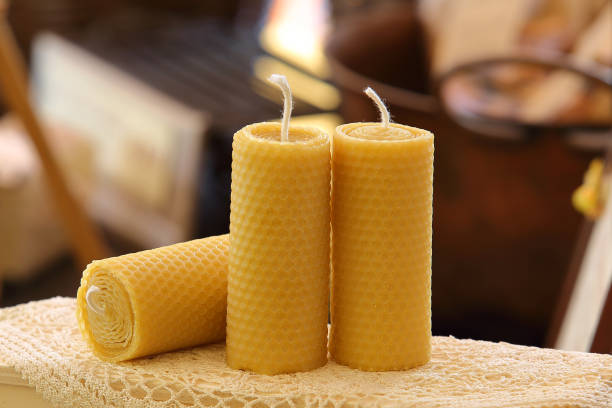
Valuable and environmentally friendly beeswax is even harder than paraffin, which allows it to be molded into intricate shapes and makes it the longest-burning of all waxes, with the warmest and brightest flame. Its density also helps it melt evenly without dripping.
Its characteristic warm yellow color and sweet smell make it particularly well-suited for coloring and flavoring, but for this purpose, bleached beeswax and compatible fragrances. The wax burns cleanly and is suitable for people who are sensitive to odors and toxins because it is hypoallergenic.
Soy wax is an entirely plant-based and renewable product that, like beeswax, burns without polluting the air or staining walls. Developed in 1991 as a cheaper alternative to beeswax and a more eco-friendly option than paraffin, it falls between the two in terms of burn time. Soy wax is also much easier to clean up—just use soap and water.
Its lower melting point means a longer-lasting fragrance. Its subtle natural scent does not interfere with the perfume oils, allowing them to stand out. Although the intensity of the scent does not exceed that of paraffin candles, it can be enhanced by selecting the right types of oils and adding them at the correct temperature. The wick is also of paramount importance.
Types of Candle Wicks
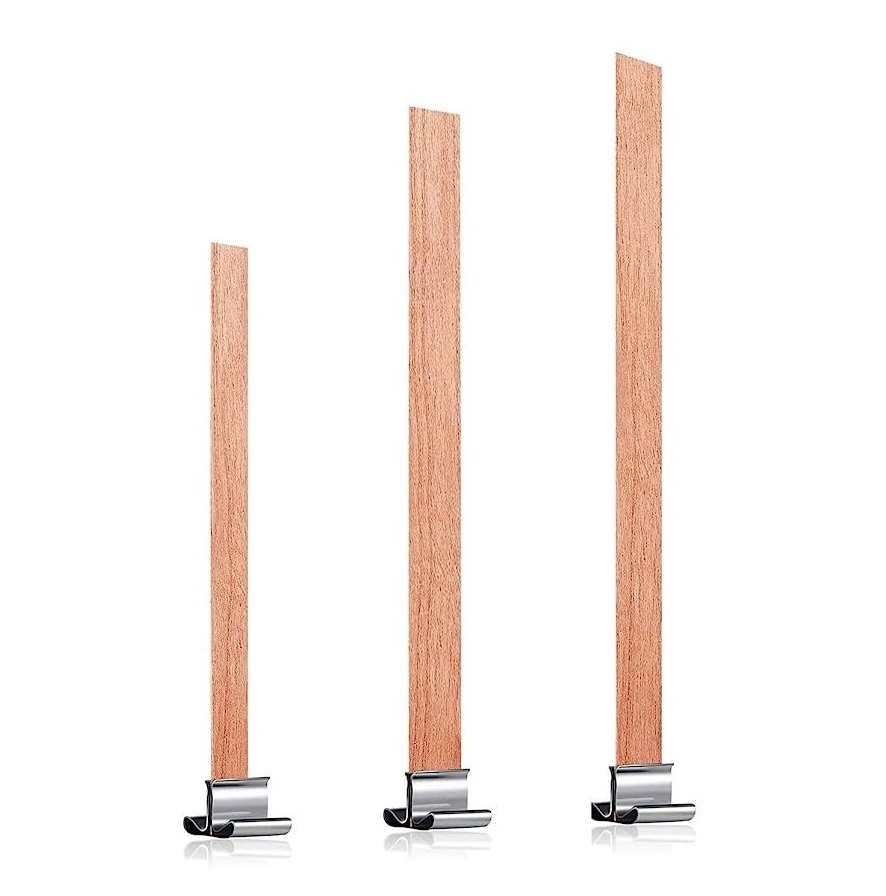
There are over 100 specific types of candle wicks with round, square, and flat cross-sections, various braids, metal or paper cores, made from cotton, flax, and other natural fibers, as well as solid wicks made from wood veneer.
At present, the Bulgarian market mainly offers knitted uncoated cotton cords, coated round cords with a metal core , and the increasingly popular cylindrical and flat wooden wicks for candles.
The thickness and length of the wick are determined by the size of the container or mold in which the candle is made, the type of wax chosen, and the percentage of fragrance added, if any. As a general rule, larger candles are paired with thicker wicks. However, for slow, even burning and fragrance release, it is sometimes better to use two thin wicks instead of one thick one.
Finding the right wick size—just like with the other candle components—is a matter of experimentation and striking a balance. The right wick melts the wax all the way to the sides of the container, burns without producing smoke or soot, does not crackle, maintains a medium-sized flame without overheating or melting the wax too quickly, and diffuses the added fragrance well.
The types of wicks we offer:


Fragrances
For best results when making candles, use perfumes and essential oils that are heat-resistant. These are the same specialized fragrances that are added to soaps. The essential oils that people often want to use are unstable at high temperatures and evaporate easily, making their addition pointless. This is further compounded by their significantly higher price. There are good fragrance oils that are phthalate-free and also eco-friendly. Another advantage is that they usually come with detailed instructions for use.
Candle Holders
Making candles in a container instead of a mold is a good place to start for beginners.
Glass jars and cups are the most common choices for this purpose. Glass comes in a wide variety of styles and colors, suitable for all kinds of designs, and allows the light of the flame to shine through. Thick glass is heat-resistant, but there is still a risk of breakage if dropped or exposed to very sudden temperature changes. It’s best to avoid using glass vases and cups with thinner walls.
In general , ceramic containers are more heat-resistant , but they are also heavier. They are suitable for souvenir candles and those with a more luxurious composition and appearance.
Tin and aluminum cans and containers can give the candles a look that ranges from more industrial to just as elegant. They are very light and unbreakable, with a higher recyclability rate (100% for aluminum). Their drawback in this case is their thermal conductivity, which can cause them to become excessively hot to the touch while burning.
In the case of handmade vessels made of porous materials such as concrete and wood, it is important to seal their surface before pouring the wax (in the case of concrete) or to use an additional container (in the case of wood).
Author: Martina Petrova


