

Coloring Agents in Paints: Dyes and Pigments
Home » Uncategorized » Coloring Agents in Paints: Dyes and Pigments
Colorants are essentially dry powders. If they are soluble in liquid (like sugar in water), they are called dyes, and if they are completely or nearly insoluble, then they are pigments.
For the artist, dyes and pigments differ in one much more significant way, and that is their lightfastness. The degree of lightfastness determines how much a color fades when exposed to light.
Dyes have low to moderate lightfastness, while pigments range from low to excellent. In other words, when not protected from light, paints and inks made with dyes will always change or fade to some extent.
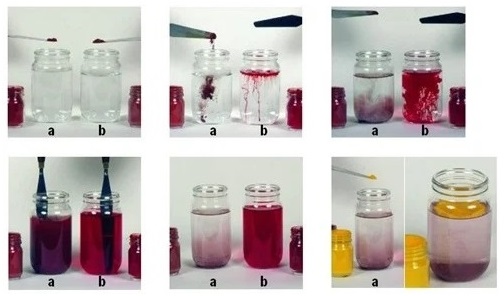
Bagriila
Because of their low lightfastness, these pigments are not used in the highest-quality professional paints for artists. Paintings are always displayed in a well-lit area, so the colors must be long-lasting.
For illustrators and designers, on the other hand, this aspect of the products may not be all that important. Illustrations are usually printed, and designs are subsequently produced from other materials, while the originals are stored in a dark place. Children and hobbyists also generally don’t have such high expectations for color fastness.
Another undesirable effect of dyes is their tendency to bleed at the microscopic level (so-called bleeding in English) — the colors seep into other color layers or into the surrounding paper fibers, even after they have already dried.
Their solubility makes them ideal for coloring thin liquids—from fruit syrups to transparent inks.
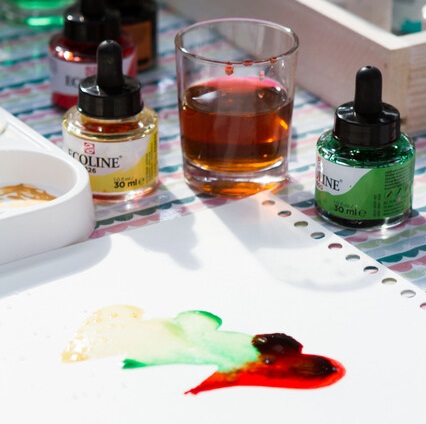
Only two of the Royal Talens (Netherlands) products we carry at Slanchogled are dye-based: the ink markers and Ecoline markers. The exceptions are the white and gold, which are made with pigments and are highly fade-resistant.
Pigment Varnishes
Lac pigments (in English, lake/lacquered pigments) are dyes that have been treated so that they are insoluble in a specific binder or solvent. This is achieved chemically by fixing the dye to a colorless inorganic pigment, which does not dissolve in the selected binder. This improves the lightfastness of the dyes, but only slightly. In addition, lacquer pigments also tend to diffuse into the fibers of porous surfaces (see bleeding above).
Over the course of history, some natural pigments have been replaced by synthetic ones produced chemically—for example, to achieve greater lightfastness, due to their toxicity, or to prevent unwanted color bleeding.

Organic pigments
Organic pigments consist of carbon compounds. Before they began to be produced synthetically, they were often derived from animals or plants. Some synthetic organic pigments include alizarin, azo pigments (found in yellow, orange, and red colors), phthalocyanine (blue-green colors), and quinacridone (a lightfast red-violet pigment).
Inorganic pigments
Inorganic pigments (of mineral origin), such as oxides, are metal compounds. Compared to organic pigments, there are very few of them. These include ochre, umber, and sienna. Examples of synthetic inorganic pigments include titanium white, zinc white, ultramarine, Prussian blue, cadmium pigments, and cobalt pigments.
We can also distinguish inorganic pigments based on their impact on health and the environment:
Fe / Iron – harmless
Pb / Lead – highly toxic
Cr / Chromium – use with caution
Zn / Zinc – Harmful to Marine Life
Co / Cobalt – use with caution
Cd / Cadmium – use with caution
Ti / Titanium – use with caution
Risks to human health are determined based on the soluble component. Pigments based on heavy metals, such as cobalt, chromium, and cadmium, are tested using a hydrochloric acid simulation.
Other requirements apply to the environment.
Lead, Cadmium, and Titanium
- Lead: The use of white lead pigment is completely banned in the European Union due to its toxicity. White lead (lead carbonate), mixed with linseed oil, forming a strong, elastic mixture. However, it also has its drawbacks: over time, the paint layer becomes transparent and turns increasingly yellow until it eventually turns black due to sulfur dioxide in the air. Royal Talens has not produced white lead paint for years, offering instead just as opaque and warm a titanium white as its substitute.
- Cadmium: Cadmium yellow contains cadmium and sulfur, while cadmium red is based on cadmium and selenium. Due to the way cadmium pigments are produced today, Mixtures containing cadmium are practically insoluble and harmless under normal use. Because of its insolubility, cadmium pigment will not be absorbed by the body in the event of accidental ingestion. Royal Talens uses cadmium pigments that meet the strictest safety requirements.
- Titanium dioxide (TiO2) is a bright white pigment used in a variety of products, including paints, synthetic materials, inks, paper, cosmetics, food products, and pharmaceuticals. In 2020, the European Commission classified titanium dioxide as a potential carcinogen when inhaled, in accordance with the European Regulation on the Classification, Labeling, and Packaging of Chemicals and Mixtures (CLP). The potential risk associated with it relates to prolonged inhalation of fine dioxide particles. During the meetings concerning the classification of titanium dioxide (TiO₂), However, it was concluded that such a risk is unlikely to arise under normal and foreseeable conditions. Regardless, as of mid-2021, all art supplies containing more than 1% titanium dioxide must include a warning about the danger of inhalation.
Index of Pigments and Colors
Manufacturers of professional paints specify the pigments, which they use. They are designated by letters and numbers according to the Color Index – an international system for verifying the pigments that make up a given color and their characteristics. The letters are an abbreviation of the color’s name, and the numbers correspond to the specific variety of pigment. For example: PW6 means Ppigment White 6, or titanium dioxide.
Here is a list of the symbols:
PW = Pigment White
PY = Pigment Yellow
PO = Pigment Orange
PR = Pigment Red
PV = Pigment Violet
PB = Pigment Blue
PG = Pigment Green
PBr = Pigment Brown
PBk = Pigment Black,
PM = Pigment Metal.
Translation from Royal Talens’ Artists’ Materials Manual (2020): Martina Petrova


