

A Brief Overview of Pencils
Home » Uncategorized » A Brief Overview of Pencils
All drawing pencils consist of a core— which we usually call graphite— and a wooden casing that holds it.
Composition of the core
Graphite pencils
The distinctive qualities of each pencil—such as color intensity, the evenness of its mark, and its softness—are determined by the raw materials used for the graphite, their proportions, and the manufacturing method. Color fastness depends on the pigments.
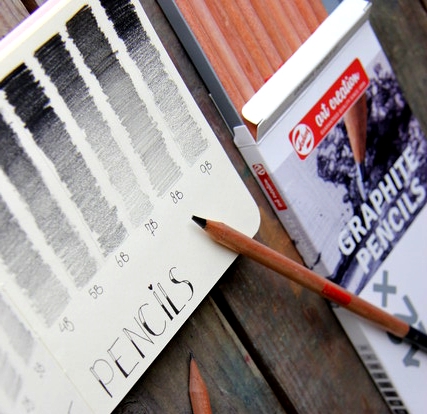
Regular graphite pencils are made from graphite, kaolin, and cellulose, while water-soluble pencils also contain an emulsifier. The more graphite the core contains, the softer and darker the pencil is. Pencil hardness is denoted by H (for “hard”), with the number preceding the designation increasing in parallel with hardness—H, 2H, 3H, and so on, up to 9H. The letter B stands for black (from the English word “black”) and corresponds to the softness of the graphite —B, 2B, 3B, up to the softest and darkest 9B. Thus, our most familiar pencil, the HB, falls in the middle as both hard and black. There is also the F grade, which allows for sharpening to a very fine point (F stands for “fine point”), and falls between HB and H; in other words , F can be considered a harder version of HB.
Colored pencils
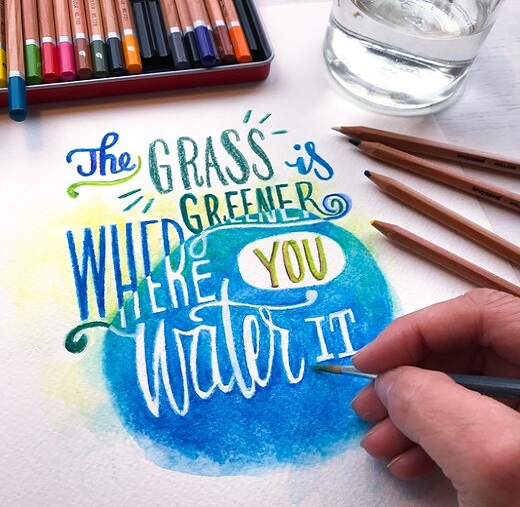
Colored drawing pencils, on the other hand, contain wax and colored pigments instead of graphite. Kaolin serves as a filler, and cellulose as a binder. The wax ensures a smooth feel when applying the color and makes it more smudge-resistant. Watercolor pencils , on the other hand, are modified so that form an emulsion when water is added and dissolve.
As for pastel pencils —they consist only of dry pigment, kaolin, and cellulose, which allows them to be blended by rubbing just like charcoal and chalk and dry pastels.
Production
After mixing The ingredients that make up the pencil core are mixed until the desired fineness is achieved. The colored mixture is then compressed and pressed through a metal cylinder with a diameter equal to that of the graphite, under a pressure of 200 metric tons, from which a continuous colored strand emerges, which is subsequently cut into pieces and fired.
Meanwhile, the wood is being prepared. The best raw material for making pencils is California cedar (Libocedrus decurrens), which is distinguished by its fine grain and straight grain, allowing the pencils to be sharpened to a very sharp point. The initial preparation of the wood involves cutting it into planks 5 meters long and 7.6 x 7.6 cm thick, which are then left to air-dry for at least one year.
The beams are then cut into slats that are half as thick as a pencil. The slats are pressure-treated with wax and stain, which gives the wood flexibility and durability. Once the channels for the graphite are formed, the pencil is assembled and glued together with a special adhesive that protects the core from breaking upon impact. The process concludes with shaping the pencil’s cross-section, applying several coats of varnish, sharpening, and stamping it with information.
Translated from Royal Talens’ Artists’ Materials Manual (2020): Martina Petrova


