

How to Decorate Your Easter Eggs with Gold Foil
Home » Uncategorized » How to Decorate Your Easter Eggs with Gold Foil
With just a few days left until Easter , we’re sharing our take on one of our favorite seasonal activities—decorating eggs for the holiday. Somewhere between decal stickers and doodling with acrylic markers , we decided to try something a little more glamorous: decorating with gold foil and gold dust.
Preparation 🥚🥚
To do this, we need:
- Boiled and cooled eggs.
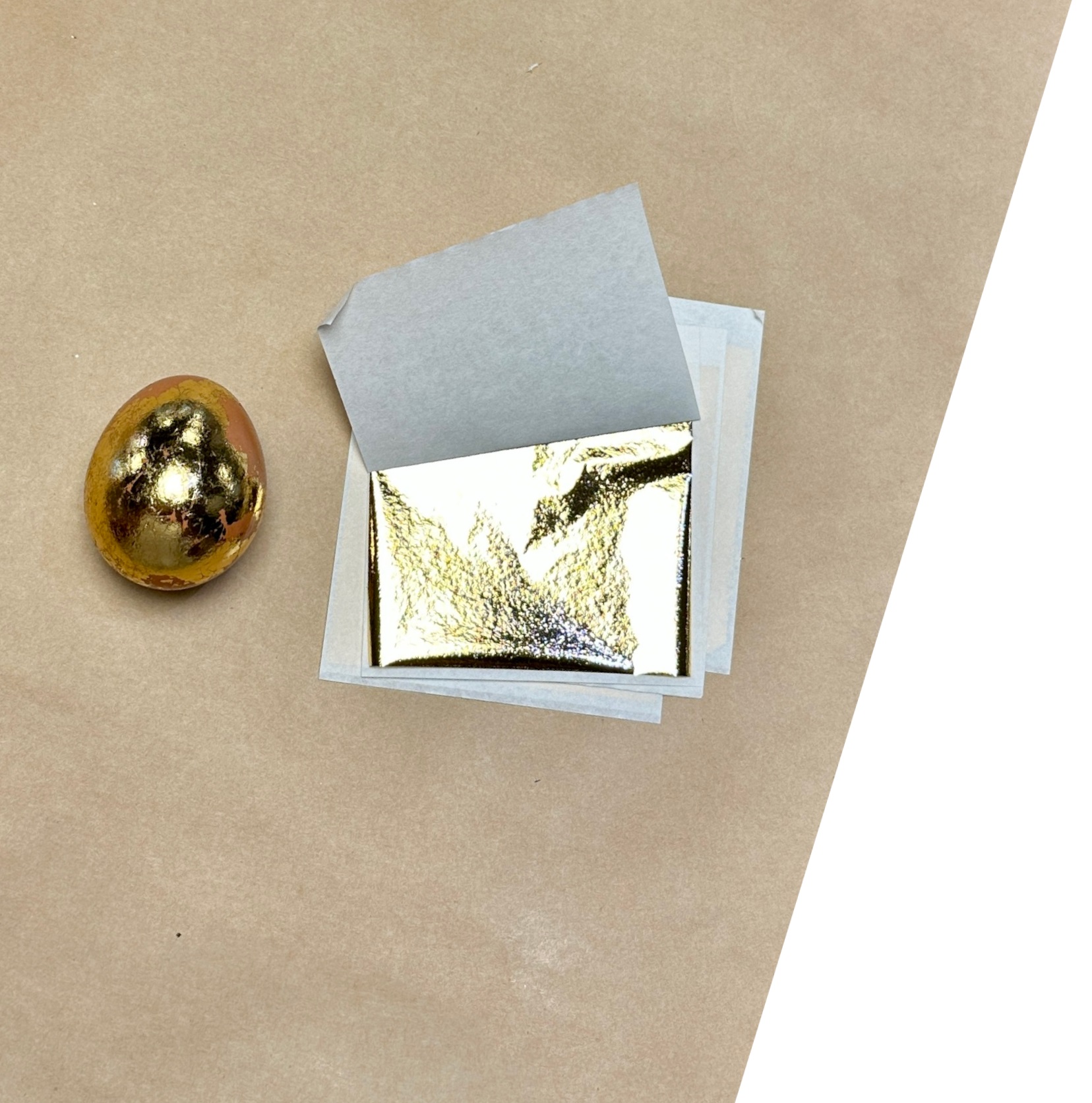
- Gold foil sheets. They are often colloquially called “varak” (which actually refers to real gold), but in fact, this is “schlagmetall,” or very thin sheets of aluminum. This in flakes for a more mottled effect.
- Flat brush
- Egg white and sugar, which will act as a harmless adhesive.
How to make the glue:
Dissolve about one tablespoon of sugar in the egg white that has been separated beforehand. We let the egg white rest after stirring. The strained mixture is used as glue.
It is also possible to glue with gelatin paints, since gelatin is, in and of itself, a type of eco-friendly, edible adhesive.
Steps for Decorating with Gold Foil ✨
Preparing our canvas for painting—the eggs 🙂:
Let the eggs dry. The darker ones look better if they’re already pale or deeply colored, while the white ones can be left as is.
Time for Glue:
Apply a first layer of glue all over the egg—this will act as a primer—and wait for it to dry.
Apply a second coat of glue to the desired areas. You can either cover the entire surface again or create an abstract pattern.
The Golden Step:
While the glue is still slightly tacky, carefully place a small piece of gold foil on it. Press it down with your fingers or a brush, then remove the excess. Repeat as desired in other places.
Our first attempt at gilding ended with us rubbing it with silver foil for hot stamping, resulting in a platinum-gold sheen.
Varnishing:
Let the decorated eggs dry completely. Then you can seal them with the glue, just like you would with varnish.
Decoration with gold dust
Decorating with gold dust follows almost the same principle. Gold dust, like metal leaf, is completely harmless. It is a pigment made from mica—a type of silicate mineral.
Pour a small amount of the egg white and sugar into a separate bowl. Mix a small amount of the pigment thoroughly with the glue. The basic ratio we can use is approximately 2:1 (glue to pigment). The result is a semi-transparent gold eyeshadow with a soft, warm shimmer. It can be applied either as a base layer over the egg or over the decoration that has already been applied.
Tips
The foil doesn’t have to be applied perfectly. A little goes a long way — slightly torn and uneven foil adds charm and uniqueness to each egg.
Gilding techniques go wonderfully with other methods of decorating eggs, such as marbling and color blending.
They’re perfect for anyone,
for those who love to experiment and want something more striking than traditional dyeing. With very little effort, we can create little works of art that will brighten up our table and add to the Easter spirit.
Author: Martina Petrova


