

Cleaning Oil Paintings
Home » Uncategorized » Cleaning Oil Paintings
Before we begin cleaning a painting, we must first make sure that it is in good condition and does not require the intervention of a professional restorer. In other words, the canvas must be intact, with no warping, holes, or wear, and the paint layer must have no deep cracks. Once these conditions are met, we can move on to the first step: removing the latest layer of accumulated dust.
Preparation
You can dust with a regular microfiber cloth that is just slightly damp. To moisten it without making it too wet, some restorers wrap a damp disinfectant cloth inside it. The liquid these cloths are usually soaked in is gentle on the skin of the hands.
Using a slightly damp cloth , we can gently—without applying pressure—remove the dust from the canvas. However, this action removes only the dust that has most recently settled on the paint layer.
Dust that has accumulated over time penetrates deeply, so to remove it completely, we need to move on to the next step. For this , we’ll need a clean container in which to mix water with a little soap. It’s recommended to use distilled water, since it’s already purified, and to use only a small amount of detergent. We can check the ratio of the two by stirring the mixture with a clean finger and ensuring that only a few bubbles form in the foam on the surface of the liquid. This is also how we check the temperature of the prepared liquid. It should be neither too hot nor too cold.
Thorough Cleaning
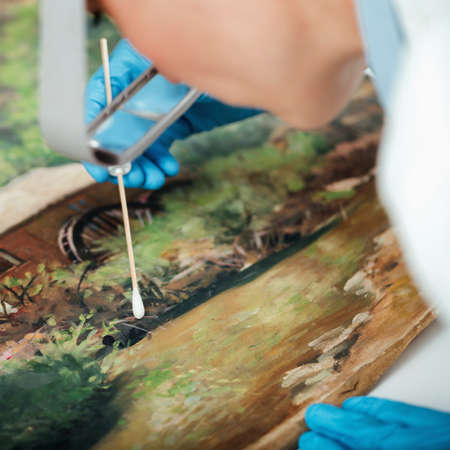
To remove dust that has already penetrated deep into the paint layer, we’ll need some more cotton and handy sticks to wrap the cotton around as swabs. For this purpose, we can also use ready-made ear swabs, for example. With the swabs prepared in this way and the soapy solution, we can proceed to the actual cleaning. Soak the swab in the liquid and gently rub the surface of the painting.
It’s a good idea to start with a very small area in one of the corners of the painting and observe the change in the color of the swab used there. If it becomes dirty and turns black as if from dust, rather than taking on the color of the cleaned area—for example, a yellow section of the canvas—we can proceed with confidence to continue the restoration work. However, it is necessary to perform this check periodically, given the varying chemical compositions of the paints used.
In addition, the pad should be changed frequently to prevent dirt from being transferred back onto the already cleaned surface.
For stubborn stains
Layered powder
Of course, there is a possibility that the accumulated dust will not respond to this treatment. In that case, we can increase the ratio of soap to water and test it again on a small section of the painting. If that doesn’t work either, it’s quite possible that the causes are complex. In that case, it’s safer to seek the services of a professional restorer, who can complete the process based on their analysis.
Yellowing
Staining on a painting may not be solely the result of the accumulation of dust particles. Quite often, the paint layer takes on a yellowish tint when exposed to cigarette smoke or stored near a kitchen. In such cases, a soapy solution may prove ineffective.
In this case, we can use a solution of distilled water and ethyl alcohol. The alcohol concentration should again be kept to a minimum; it is recommended to start with a solution of about 30% alcohol in water.
Once again, use a cotton swab, rubbing it gently and carefully across the surface, following the same recommendation to monitor the swab. If, for any reason, the swab changes color relative to the color of the treated surface, it is best to stop the process and consult a conservator.
If everything is fine but the yellowish residue won’t come off, then we can increase the ratio of alcohol to water and again watch for any adverse reactions. The maximum percentage of alcohol in the solution should not exceed 50%.
Cleaning with turpentine as a last resort
The final challenge we might face when attempting to clean an oil painting is complex contamination from various sources.
This situation could also arise if, for example, we do not know the history of our canvas—where it was stored and what contaminants were nearby.
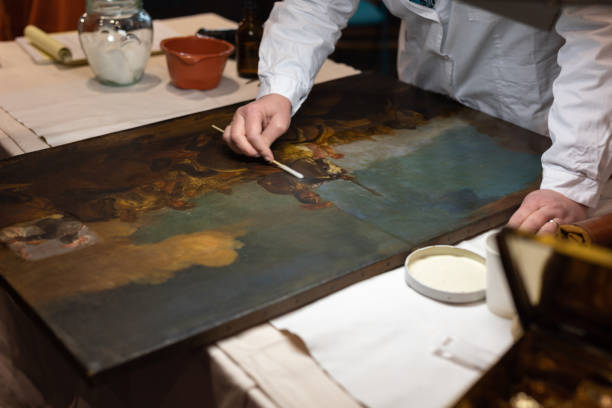
In this final option , the solvent that can be used to treat the contamination is turpentine. The method of application is the same as for the methods listed above using water or alcohol.
Here, monitoring the cleaning swab is of the utmost importance and should be done frequently when moving on to new areas. Turpentine is also the strongest solvent we can use on our own without professional help.
This means that if, despite our best efforts, there are still stained areas on the treated surface, it is again advisable to consult a professional restorer to complete the restoration process.
Varnishing
The final step after completing the canvas cleaning process is to apply a protective varnish to the restored paint layer.
In this case, most professionals recommend choosing one that is acrylic-based. Its chemical composition would prevent particles from the varnish layer from penetrating and mixing with the paint layer—and vice versa—a process also known as migration.
Acrylic varnish can be removed and replaced periodically every few decades. However, its protective properties are just as high as those of other types of roof varnishes.
With this final step, the process of cleaning and refreshing our canvas is complete. It can be displayed again and bring joy to our daily lives.
Restoration as a Portal Through Time
The restoration and conservation of oil paintings can hardly be easily classified as one of the countless types of hobbies.
Given that a work of art belongs to the realm of culture and history, restoration as a profession quite often requires specialized training.
And it is probably precisely the “secrets” behind this professional training that also spark our collective curiosity about this art form, which brings history to life.
Because that is precisely the result of a professional restoration—restoring the splendor of a bygone era.
It acts as an omniscope that, while remaining on the surface, provides information about the invisible inner layers of history.
Research: Radoslav Hristov
Author of the text: Zlatka Yaromova


