

What is the main difference between acrylic and tempera paints?
Home » Uncategorized » What is the main difference between acrylic and tempera paints?
When wet, the dense and creamy acrylic and tempera paints* They appear to be indistinguishable. But in fact, they represent two quite different means of expression with various applications and capabilities. Here, we’ll take a look at what they are.
*Although gouache, poster paint, and tempera are different by definition and composition, in this article we will use these terms interchangeably.
How are they similar?
The main similarity between the two is that they can be mixed with water. With both types of paint, a watercolor-like effect is achieved watercolor-like . Their consistency is also quite similar, with the exception of specialized thick varieties of acrylic paint suitable for impasto techniques. Usually, acrylic paint is sold in tubes and large plastic jars, while tempera is sold in small jars and tubes.
How are they different?
The differences between acrylic paints and gouache, which become apparent as you work, definitely outweigh the few similarities that are apparent at first glance.
Water solubility after drying
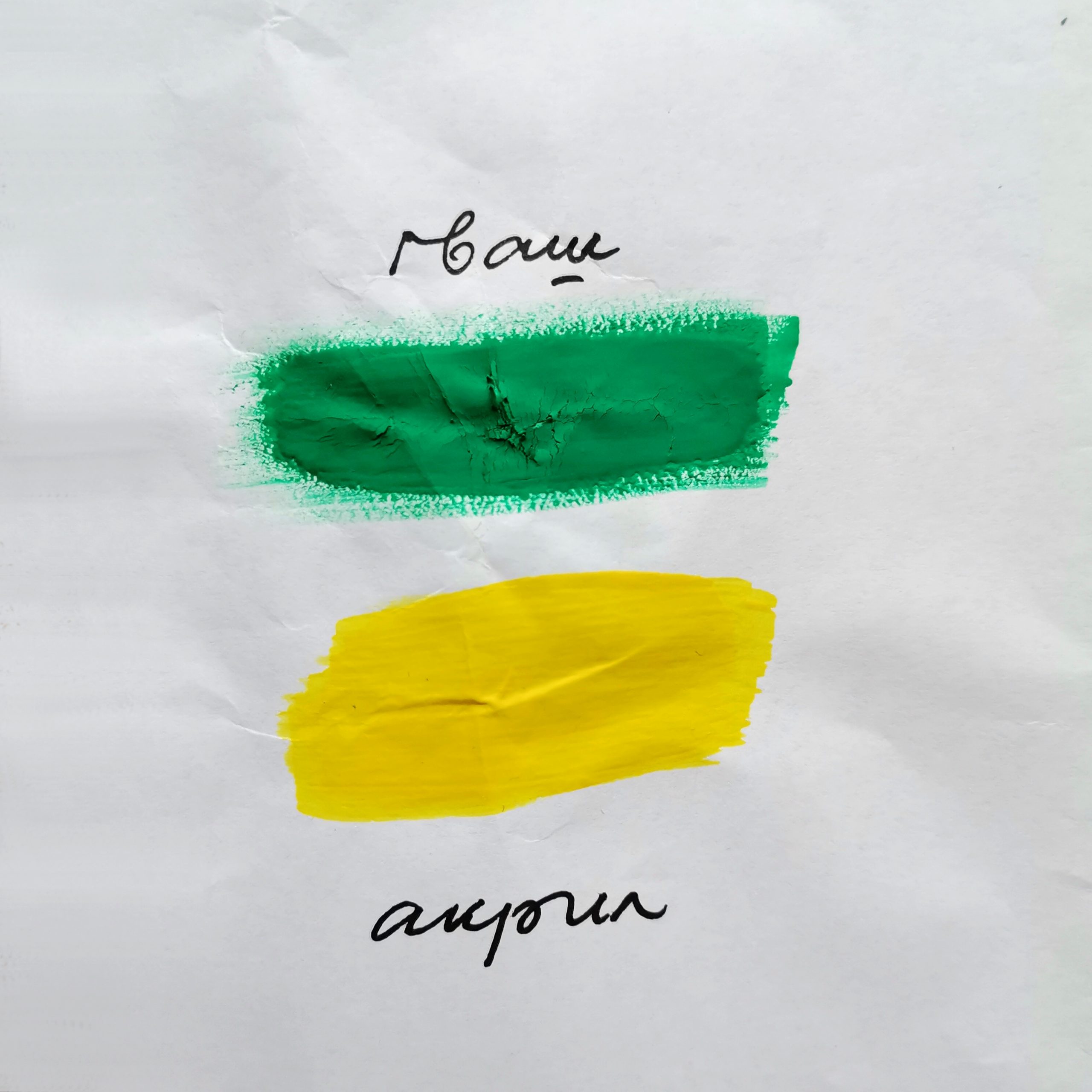
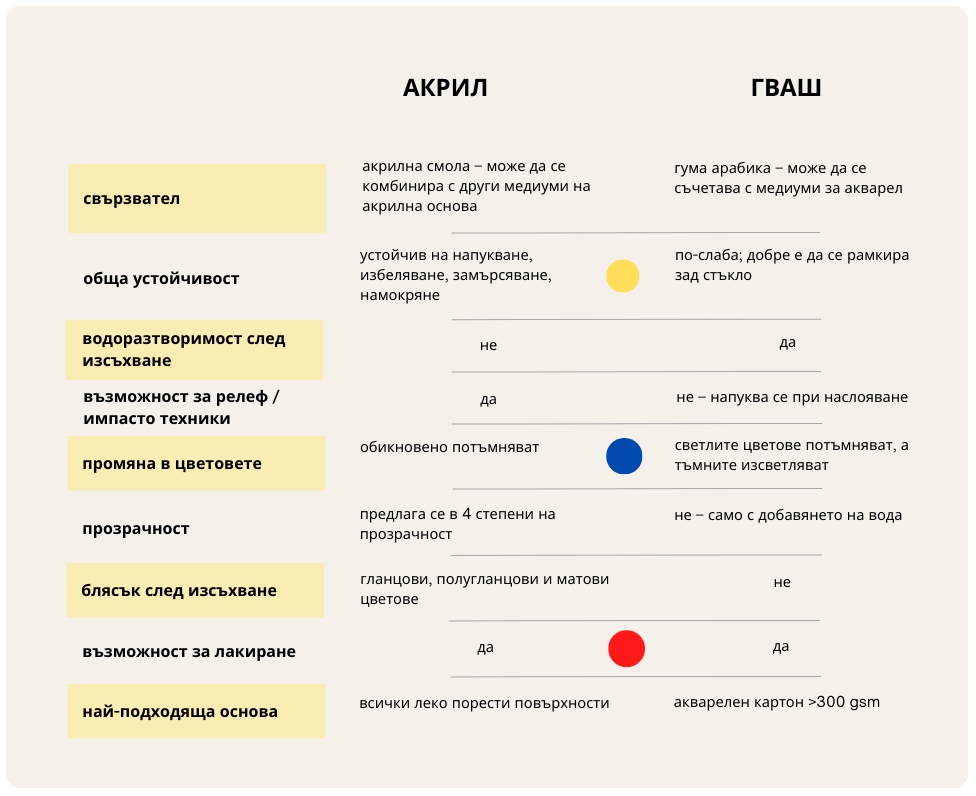
The most important one is regarding water resistance. Since acrylic is made on the basis of acrylic resin, which forms a plastic layer after the water evaporates, it cannot be redissolved with water after drying. This means that acrylic brushes must be cleaned before the colors on them harden. On the other hand, this is not a problem for tempera , whose binder is gum arabic . Like watercolor, it can be left to dry on the palette and then used again. The same applies to colors on paper, which can be corrected (partially) with a wet brush.
Overall Sustainability
The next main difference lies in the durability of the colors after drying. The polymer layer that is obtained from acrylic paint is much more resistant to cracking, fading and dust. Thus, acrylic paintings are much easier to display. Gouache , on the other hand, is a much more delicate medium. It is susceptible to cracking if applied thickly, as well as to contamination, as it is much more porous. Traditionally, it is protected by placing it behind glass, but varnishes for tempera paints with a UV filter and different gloss are also available on the market.
Possible techniques
With their variety of consistencies, transparencies, gloss levels, and mixing additives, acrylic paints certainly offer more ways to use them:
- The consistency of the paints varies by manufacturer, with some brands offering lines of very thick paints for impasto
- There are 4 different levels of transparency, denoted by ☐, ⧄, ◩, and ■, which represent transparent, semi-transparent, semi-opaque, and opaque colors, respectively. This allows the artist to choose the opacity level according to their goals
- The natural sheen of acrylic paints can be enhanced or matted using appropriate additives, as well as with glossy, semi-matte, or matte varnish after the painting is finished
- Acrylic paints can be combined with a variety of mediums that alter the properties of the colors or add a three-dimensional quality and texture
- They come in a wide variety of forms to suit the artist’s different needs: paints of varying consistencies, inks, markers and sprays, which can be further modified with various mediums
- They can be applied not only with a brush, but also with straight and decorative spatulas
- Last but not least, acrylic paint can also be used for gluing in mixed-media paintings and collages with three-dimensional elements.
As for tempera paints:
- By definition, they are designed to be thick, creamy, and completely matte, so this combination of qualities is the only variation available
- As we mentioned, transparency in poster paints is achieved solely by diluting them with water
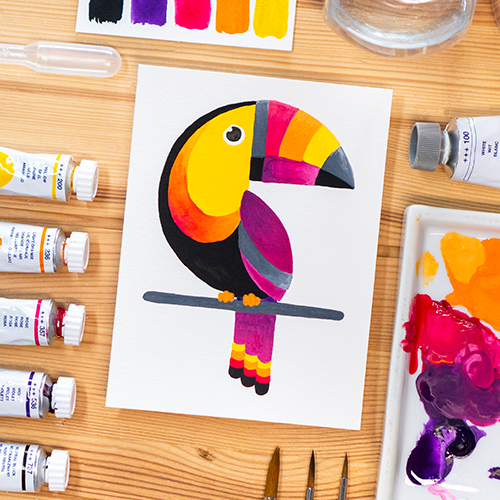
- Gouache is applied thinly and evenly, preferably on paper, and in that sense is a much more two-dimensional medium for painting. Textures are created visually through the interplay of the brush, rather than in the literal sense of roughness or relief.
- It dries more slowly than acrylic paint and can be re-wetted, which gives you more time to mix colors
- Despite its more limited application, the tempera stands out for its vivid and high-contrast appearance, as well as its softer and more “romantic” look, which is useful in the fields of design and illustration.
Work Surface
The acrylic, which acts as an adhesive, adheres to a wide variety of surfaces – paper, cardboard, canvas, wood, stone, clay, plastic, glass, and metal, and can be used for kraft paper purposes and Coloring Objects. When applied to non-absorbent surfaces, such as the last three, it tends to peel off, but only when pressure is applied.
Gouache also adheres well to porous paper, canvas, wood, stone, and clay; however, given its fragility and tendency to reabsorb water after drying, for creative purposes it is best to paint on watercolor paper or mixed media. The optimal weight for this purpose is >300 gsm, and the paper does not necessarily need to contain cotton. For a tinted background, you can use plain colored or kraft cardstock, again in accordance with the recommended weight.
Acrylic gouache
Beyond the traditional definitions of acrylic and tempera paint, a type of paint known as acrylic gouache has been developed, which combines the best features of both mediums. Acrylic gouache is, in practice, a very matte and highly pigmented acrylic paint. It layers easily without dissolving the underlying layers, as it dries quickly and is water-resistant. As with regular acrylic paint, it can be used on various slightly absorbent surfaces without fear of the dry paint cracking. Acrylic tempera can be mixed with various acrylic paint additives, which thin the colors but make them more flexible and water-resistant once dry.
Author: Martina Petrova


